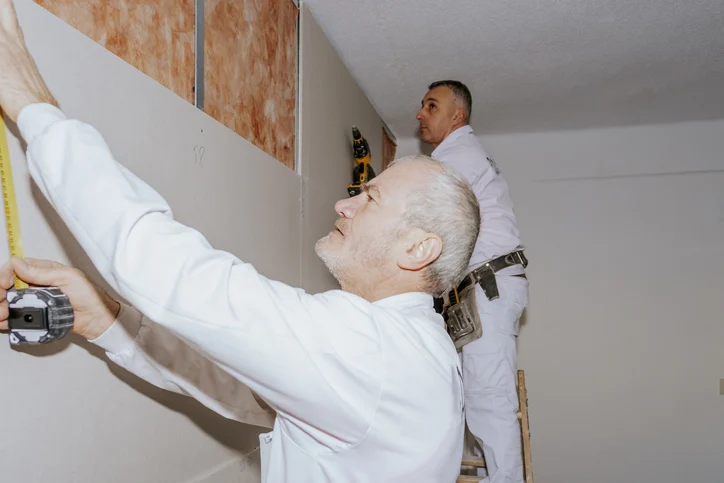
Working in the field of soundproofing, acoustics and noisy neighbour solutions, one of the most frequently asked questions is, ‘What is the best soundproofing material?’.
The first thing you need to consider are the types of sound transmissions, as they require different capabilities from soundproofing materials and acoustic insulation. There are two types of noise transmission: airborne and impact; each of these variants call for a particular solution or soundproofing treatment.
In this article we will be discussing the different types of soundproofing, and exploring why soundproofing is important, as well as which materials are the most effective at combating both airborne and impact sound.
What is soundproofing?
When we discuss soundproofing we are referring to the reduction of unwanted sound at its source in dwellings, residential buildings, offices and schools, etc.
Soundproofing and acoustic insulation are two terms that are often used interchangeably as they both aim to block the passage of sound. However, they possess different properties that work together in order to pass Part E regulations in Approved Document E.
Acoustic insulation (mineral wool) is used in cavities to absorb sound, whereas soundproofing blocks sound within walls, floors and ceilings through the addition of mass. In order to soundproof effectively, a combination of soundproofing and acoustic insulation is best.
How does soundproofing work?
Sound travels as a vibration when it hits a surface such as a wall or floor. To lessen these vibrations and stop them travelling through a building, you need to dampen the vibrations.
Soundproofing solutions help walls, floors and ceilings to block sound. However, sound can still escape and reverberate in the cavities of party walls and joists. This is where acoustic insulation comes in, as it absorbs this sound to avoid flanking transmissions.
Soundproofing is all about adding mass to a structure to increase its density and resilience to sound passing through. Different materials possess different capabilities when it comes to blocking and absorbing sound, so using a combination of materials is the most effective approach.
The best soundproofing materials need to be heavy because mass blocks sound. It is through the addition of mass that soundproofing works as this dampens the noise vibrations.
Why do I need soundproofing?
Soundproofing and acoustic insulation are necessary to pass Part E building regulations, but why are these regulations in place?
The main aim of the regulation is to avoid tension between residents in adjoining rooms/buildings. However, it has been proven that soundproofing can have an extremely positive impact on your quality of life.
Unwanted noise is a large cause of stress as it is difficult to relax when you can hear those around you, and also when you’re constantly worrying about whether they can hear you in return.
Privacy in your own home is important, by installing a soundproofing system you can prevent neighbours from overhearing your private conversations, and from disturbance due to music, television or unwanted noise.
Your health is another reason to consider soundproofing. Prolonged exposure to sound and noise has been proven to have physical effects on the human body such as high blood pressure, strokes and heart diseases.
Soundproofing is also an effective way to avoid hearing loss problems, sleep disturbance and cognitive impairment. Unwanted noise causes annoyance, which can lead to stress and exhaustion. Sleep disturbance has a massive impact on a person’s alertness and even their performance at work.
Therefore, soundproofing should be important for everyone, not just builders and developers. By reducing unwanted noise, you are positively impacting your quality of life.
How do I combat airborne noise?
Airborne noise is, quite simply, noise that travels through the air. Air is made up of atoms and molecules, and sound is a kinetic energy that passes from molecule to molecule. Examples of airborne noise include talking and television noise.
The best way to reduce the transmission of airborne noise is with dense materials. A substance that is more dense per volume has more mass per volume. Larger molecules have more mass and transmit sound much slower than smaller molecules.
What are the best materials to combat airborne noise?
Here is a list of construction materials with the necessary density to combat airborne noise;
- Mass-Loaded Vinyl (such as Karma Soundlay, Acoustiwall, CMS WB)
- Cement Particle Board (such as Versapanel & Versafloor)
- Rock Fibre Slab (such as these Rockwool products)
- Chipboard (such as Karma Overlay 23 & 28, and Visco 400 & 600)
- MDF Fibreboard (such as Visco 17 & 21)
- Gypsum Board (such as Smartfloor)
- Plasterboard (such as Acoustiwall)
- Mineral Wool (such as these Rockwool products)
- Polymer Membrane
- Weight Enhanced Barrier
- (such as Karma Soundlay, CMS WB)
How do I combat impact noise?
Impact noise is more accurately referred to as structural-borne noise, and is noise that is transmitted through the physical elements of a building. Examples of impact noise include footsteps and moving furniture.
The best way to reduce the transmission of impact noise is to use materials that are more absorbent, or resilient.
What are the best materials to combat impact noise?
Here is a list of construction materials to combat impact noise.
- PUR Foam
- Cork
- Rubber Crumb
- Woodfibre (this is the resilient layer on the product Smartfloor 28WF)
- Chip Foam (you can find this used on products such as Acoustilay)
- Visco Elastic (these Visco products are bonded with a Visco Elastic strip)
- Cross-Linked Polyethylene
- Closed-Cell Polyethylene
What are the best soundproofing solutions for combating airborne and impact noise?
When soundproofing a party wall against the noisy shenanigans of an inconsiderate, noisy neighbour, you will generally be looking for a means of combating airborne noise. Here are our recommendations of the most effective products for you.
Karma AcoustiWall 2
Karma AcoustiWall 2 is a 24mm thick system for walls, allowing for superior noise reduction on block, brick or stud walls. This is perfect for combating muffled conversation, and due to its thickness, the AcoustiWall 2 is almost undetectable when mounted on the wall.
The Karma AcoustiWall 2 has an airborne rating of 46 dB, which exceeds Document E Building Regulations (this figure isn’t a measure of the reduction that the product gives, but is the figure that you would get following a soundproofing test).
The product features a layer of fire retardant acoustic plasterboard and mass-loaded vinyl, adhered to a laminated acoustic layer. Acoustic plasterboard has a much higher density core than standard plasterboard, meaning that the sound energy gets trapped between the boards as it passes through, resulting in a reduction of airborne noise pollution. Mass-loaded vinyl absorbs sound waves and prevents them from bouncing off of surfaces.
The acoustic layer is a 9mm soundlay that is a high performance barrier mat made up of CMS WB7.5 and a 6mm layer of class 0 acoustic foam. CMS WB7.5 is a weight-enhanced high density, barium sulphate loaded, thermoplastic polymer that traps the sound energy and reduces vibrations.
Class 0 is the best building regulations designation for materials that protect against the spread of flames, and due to its high density, it also possesses excellent sound absorbing abilities.
Karma AcoustiWall 3
Karma AcoustiWall 3 is a 30mm thick system for walls, allowing for superior noise reduction on block, brick or stud walls. The AcoustiWall 3 is slightly thicker making it perfect for blocking out clear conversation.
The Karma AcoustiWall 3 has an airborne rating of 60 dB which exceeds Document E Building Regulations.
There is a 14 dB difference between the airborne rating of AcoustiWall 2 and AcoustiWall 3, but it is important to remember that decibels do not work on a linear scale. An increase in 3 dB translated to sound intensity would actually be two times louder to the human ear.
Like the Karma AcoustiWall 2, this product features a layer of fire retardant acoustic plasterboard and mass-loaded vinyl, adhered to a laminated acoustic layer. Acoustic plasterboard has a much higher density core than standard plasterboard, meaning that the sound energy gets trapped between the boards as it passes through, resulting in a reduction of airborne noise pollution.
The acoustic layer in this product is a 15mm soundlay that is a high performance barrier mat made up of CMS WB7.5 and a 6mm layer of class 0 acoustic foam. CMS WB7.5 is a weight-enhanced high density, barium sulphate loaded, thermoplastic polymer that traps the sound energy and reduces vibrations.
Class 0 is the best building regulations designation for materials that protect against the spread of flames, and due to its high density, it also possesses excellent sound absorbing abilities.
If you’re looking to soundproof a floor against a noisy neighbour below, again, you’re looking at a dense material to reduce impact noise. Here are our recommendations for products that will help you combat impact noise.
Regupol Sonus 3912
Regupol Sonus 3912 is a high performance impact noise reduction matting, used to sandwich between layers in the subfloor or directly beneath carpet and underlay and is our bestselling and most effective floor impact soundproofing solution.
This method requires a stiffening layer before the final floor finish unless the floor is 15mm and engineered wood. If you are unsure please consult our specialists who will advise you.
The impact noise reduction mat is manufactured using a tough and durable 6mm polyurethane foam. This sound absorbing foam forms a partition that stops or dampens vibrating sound waves.
The foam softens surfaces and reduces reverberation by trapping sound waves and converting them into heat which makes it a very effective soundproofing solution. This product will give you an impact reduction of 10dB when used as a stand alone solution, or it can be incorporated into a full floor system.
Regupol Sonus 4515 Multi 4.5mm
Regupol Sonus 4515 Multi 4.5mm is a tough, resilient acoustic underlay manufactured from PUR foam and cork granules. This particular underlay can be laid directly beneath carpet, laminate, ceramic tile flooring etc making it extremely versatile and perfect for all.
This product is made up of a combination of materials, so it is very effective as a soundproofing solution. PUR foam is a sound absorber which causes sound waves to convert to heat energy which reduces echo, while cork is a sound deadener that causes sound waves to dissipate against a surface before it can pass through.
If you’re looking to reduce the amount of noise coming from the room or apartment above, the most effective solution is going to be a product applied to the floor of the space where the problem originates.
It can be beneficial in this instance to use materials that tackle both airborne and impact noise. Soundproofing products that combat both airborne and impact sounds are usually created from combinations of materials.
For example, a soundproofing product comprising a two-layer laminate, the upper being a layer of CMS WB7.5 acoustic barrier supported by a 6mm layer of class 0 acoustic foam such as our Karma Soundlay products would successfully combat both.
Karma Soundlay 9mm, 12mm and 15mm
The Karma Soundlay comes in three different thicknesses, each product possesses soundproofing qualities, but a thicker soundlay is the most effective when it comes to soundproofing.
Karma Soundlay is a high performance noise barrier, reducing both impact and airborne sound where superior noise control is necessary. The soundlay is ideal for both concrete floor and timber floor applications, and is easy to install.
This two-layer laminate is made up of a CMS WB7.5 acoustic barrier, supported by a 6mm class 0 acoustic foam. These materials combat airborne and impact noise by absorbing and trapping sound vibrations.
At FWDirect we have a magnitude of effective and competitive soundproofing products that will help you soundproof your house, no matter your situation. If you’re not sure which products are right for you, contact us for expert technical advice today.
See below a table of soundproofing materials:
| Soundproofing Material | Soundproofing Material Type | Noise Type Treated |
| Cement Particle Board | Dense | Airborne Noise Transmission |
| Chip Foam | Resilient | Impact Noise Transmission and Vibration |
| Chipboard | Dense | Airborne Noise Transmission |
| Closed-Cell Polyethylene | Resilient | Impact Noise Transmission and Vibration |
| Cork | Resilient | Impact Noise Transmission and Vibration |
| Cross-Linked Polyethylene | Resilient | Impact Noise Transmission and Vibration |
| Gypsum Board | Dense | Airborne Noise Transmission |
| Mass-Loaded Vinyl | Dense | Airborne Noise Transmission |
| MDF Fibreboard | Dense | Airborne Noise Transmission |
| Mineral Wool | Dense | Airborne Noise Transmission |
| Plasterboard | Dense | Airborne Noise Transmission |
| Polymer Membrane | Dense | Airborne Noise Transmission |
| PUR Foam | Resilient | Impact Noise Transmission and Vibration |
| Rock Fibre Slab | Dense | Airborne Noise Transmission |
| Vinyl | Dense | Airborne Noise Transmission |
| Visco Elastic | Resilient | Impact Noise Transmission and Vibration |
| Weight Enhanced Barrier | Dense | Airborne Noise Transmission |
| Woodfibre | Resilient | Impact Noise Transmission and Vibration |